Why is the 2027 eclipse so long, and is it really the eclipse of the century?
The 2 August 2027 eclipse lasts up to 6 minutes 23 seconds. Why it runs so long, why 'longest of the century' is wrong, and what the UK and US will see.
The short version
- What’s happening: On 2 August 2027, totality peaks at about 6 minutes 23 seconds over Egypt. A close Moon, a small-looking Sun and a slow shadow all line up.
- Why now: Headlines call it the longest eclipse of the century, but the catalogue ranks it second, behind 22 July 2009. Interest is likely to build towards next August.
- Should you care: Most readers will be outside the path. The UK gets a partial eclipse of up to about 48%, and the US barely gets one, so eye protection matters throughout.
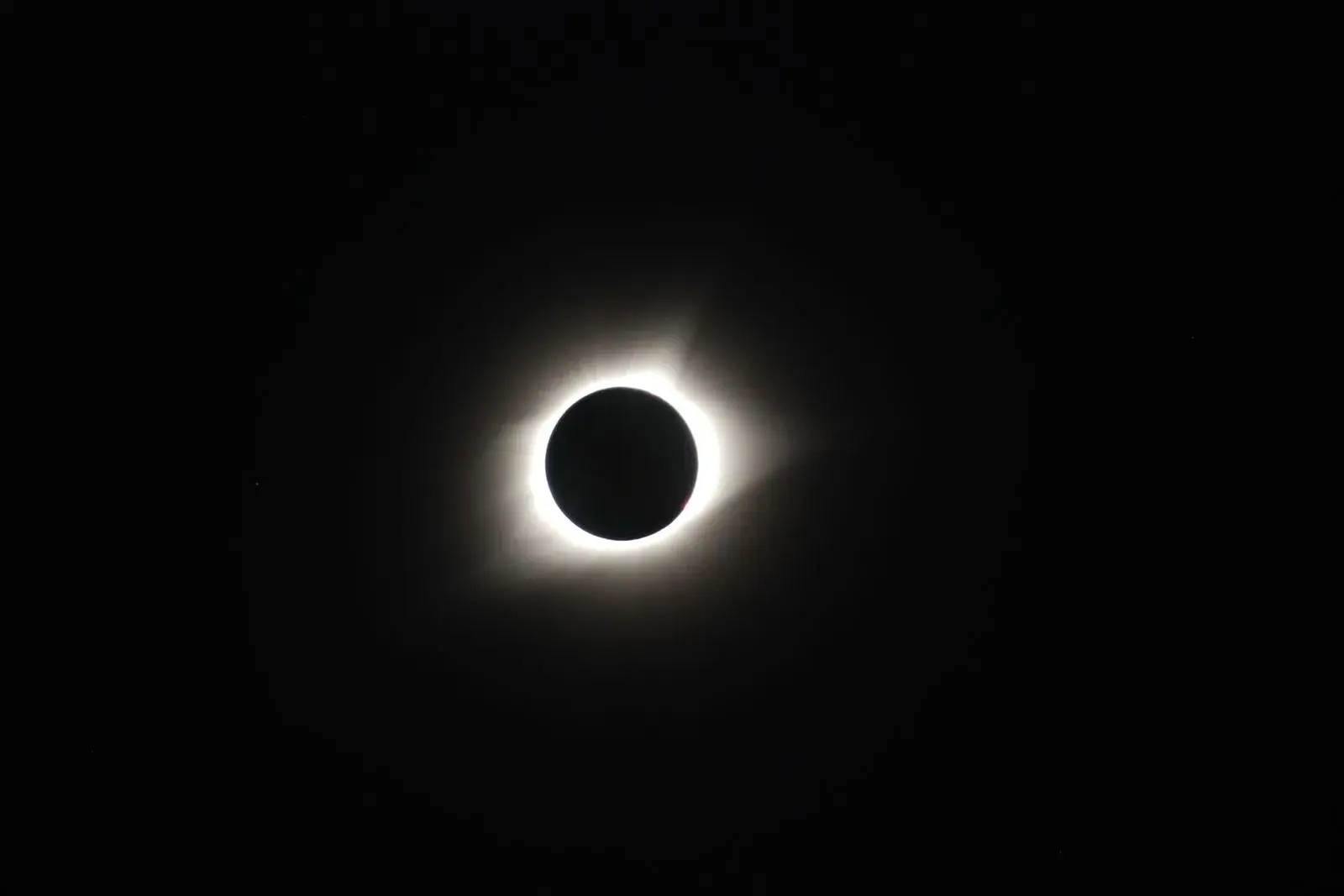
Why is the 2027 eclipse so long? The Moon is almost at its closest to Earth, the Sun looks close to its smallest, and the shadow crosses fairly low latitudes around midday. Totality peaks at about 6 minutes 23 seconds. That’s the second-longest this century, behind 2009, and not the longest.
Will the 2 August 2027 eclipse reach you?
Start here, because most people reading about this eclipse won’t be standing in its path.
- Inside the path: NASA lists southern Spain, parts of North Africa from Morocco to Egypt, Saudi Arabia and Yemen. You get totality, and how long depends on where you are.
- In the UK: a partial eclipse only, with about 42% of the Sun covered in London around 10:00 BST.
- In the US: almost nothing. NASA names northern Maine, and the view there is very brief.
- Elsewhere in Europe and eastern Canada: a partial eclipse, according to the same NASA page.
If you’re outside the path, the Sun never fully disappears. That changes the safety advice, which we cover below.
How it spread
- 22 Jul 2009The longest total eclipse of this century reaches 6 minutes 39 seconds, at a point over the Pacific.
- Jul 2026The Wikipedia article on the 2027 eclipse gets 44,935 views, ahead of the August 2026 total eclipse.
- Aug 2026Views of the same article jump to 378,040 in the month of the 2026 eclipse.
- Oct 2026Views settle at 18,538, still with about ten months to go.
Why is the 2027 eclipse so long? Three things line up
Totality lasts as long as the Moon’s shadow takes to pass over you. So the length comes down to how wide the shadow is and how quickly it moves across the ground. Long eclipses happen when a big Moon, a small Sun and a slow shadow arrive together.
| What matters | On 2 August 2027 | Effect |
|---|---|---|
| Moon’s distance | Closest approach at 06:28 GMT, 357,362 km away | Moon looks large |
| Earth’s distance from the Sun | Farthest point on 5 July, 28 days earlier | Sun looks small |
| Where the shadow falls | About 27°N, with the Sun near 81° high | Shadow moves slowly |
The Moon. Its closest point comes under four hours before the moment of greatest eclipse. That closest approach is only 77 km further out than the closest of the whole year, in January 2027.
The Sun. Early July is when Earth is furthest from the Sun, and four weeks later it has barely moved closer. Together with the close Moon, this gives an eclipse magnitude of 1.079, so the Moon’s disc looks about 8% wider than the Sun’s.
The shadow. The Moon’s shadow sweeps eastwards, and the ground rotates eastwards underneath it. Earth’s spin is fastest at the equator and slower towards the poles, so low latitudes keep up with the shadow best. Our own arithmetic: about 1,670 km/h at the equator, and about 1,500 km/h at 27°N.
A near-overhead Sun helps too, because the shadow lands almost head-on instead of raking across the ground at an angle.
It’s the second-longest this century, not the longest
Headlines call this the longest eclipse of the 21st century. The EclipseWise catalogue, compiled by retired NASA Goddard astrophysicist Fred Espenak, lists 22 July 2009 as the longest instead. The gap is 16 seconds.
| Date | Longest totality | Family (Saros series) |
|---|---|---|
| 20 June 1955 | 7m 08s | 136 |
| 30 June 1973 | 7m 04s | 136 |
| 11 July 1991 | 6m 53s | 136 |
| 22 July 2009 | 6m 39s | 136 |
| 2 August 2027 | 6m 23s | 136 |
| 12 August 2045 | 6m 06s | 136 |
| 3 June 2114 | 6m 32s | 139 |
| 13 June 2132 | 6m 55s | 139 |
| 16 July 2186 | 7m 29s | 139 |
Figures are from the catalogues for 1901 to 2000 and 2101 to 2200, as of November 2026. Calculators can differ by a second or so. Treat 6m 23s as “about”.
The table also settles two other common claims. It isn’t the longest in 100 years, since 2009 and 1991 were both longer. And the next longer one isn’t in 2132, because 2114 beats it first.
2009 and 2027 are the same eclipse family, and it’s losing time
Eclipses repeat in families called Saros series, with members about 18 years and 11 days apart. 2009, 2027 and 2045 are consecutive members of Saros 136.
Each return lands about 11 days later in the calendar. The catalogue also shows the point of greatest eclipse creeping north, from 15°N in 1955 to 24°N in 2009 and 26°N in 2027.
The catalogue gives the numbers, not the reasons, so what follows is our reading of them:
- The dates are drifting away from Earth’s farthest point from the Sun, known as aphelion. 2009 fell 18 days after it, and 2027 falls 28 days after it.
- The path is drifting away from the equator. Further north, the ground moves more slowly beneath the shadow.
- The Moon doesn’t explain the gap. It passed slightly closer in 2027 (357,362 km) than in 2009 (357,465 km), yet 2009 lasted longer.
Latitude seems to matter as much as the calendar. 1991 sat nearer aphelion than 1955, but it ran 15 seconds shorter and was seven degrees further north.
So 2027 isn’t long by chance. It’s a strong member of a family past its peak.
Saros 139 is doing the opposite. Its dates and latitudes are moving towards the best conditions, which is why it takes over the record table next century.
Why people still call it the eclipse of the century
The nickname is a label and not a measurement, but there’s a fair idea behind it: who can actually get under the longest part.
The 2009 maximum happened over the ocean, south of Japan’s Bonin Islands. Wikipedia’s table gives Shanghai, the largest city in that path, about 5 minutes. In 2027, the peak falls over Egypt, on land and close to the Nile valley.
Wikipedia’s wording is that 2027 is the longest this century on “easily accessible land”. “Easily accessible” is doing the work in that claim.
You may also read “longest on land since 1991”. We couldn’t support that. Wikipedia’s 2009 article, citing a Japanese eclipse site, gives 6m 26s on Akusekijima, a small inhabited island. If correct, that beats 2027’s maximum by three seconds.
Here’s what you can safely say:
- True: the longest since 2009.
- True: the longest for the rest of this century.
- True: nothing longer, anywhere, until 3 June 2114.
- Attributed: the longest on easily accessible land this century, according to Wikipedia.
- False: the longest of the 21st century.
Your seat in the path decides your minutes
The headline figure applies only on the centre line, near one point. EclipseWise puts the longest totality at 26°48.8’N, 31°08.0’E, in Egypt, in a path about 257 km wide. Move towards the edge and the time falls quickly.
Wikipedia’s table of places shows the range:
- Luxor: about 6m 22s.
- Cádiz: about 2m 56s.
- Madrid: no totality, only about 86% of the Sun covered.
Many pieces give Luxor 6m 23s. By our reckoning from the coordinates, the longest-duration point is about 200 km north-west of the city.
EclipseWise also lists a separate “greatest eclipse” point south-east of Luxor, with 6m 22.64s. The difference is under a second, so it won’t change anyone’s experience.
This isn’t a travel guide. For the exact path, use NASA’s eclipse page, and check official travel advice from your own government before planning a trip.
What will the UK and US see?
In the UK, expect a bite out of the Sun in mid-morning, not darkness. BBC Sky at Night Magazine gives 48% in the Isles of Scilly, 42% in London and 13% in Shetland.
| City | Sun covered | Starts (BST) | Peak (BST) | Ends (BST) |
|---|---|---|---|---|
| London | 42% | 09:03 | 10:00 | 10:59 |
| Birmingham | 38% | 09:04 | 09:59 | 10:56 |
| Manchester | 35% | 09:06 | 09:59 | 10:55 |
| Edinburgh | 27% | 09:11 | 10:00 | 10:51 |
For UTC, subtract one hour. These come from one online calculator, Orbital Radar, whose London figure matches Sky at Night’s, so check again nearer the date.
In London the Sun will be about 40° up in the east-south-east, so choose a spot with a clear view that way. Weather can’t be known yet.
In the US, USA Today, citing Time and Date, reports a window of 5:14 to 5:19 a.m. ET in parts of Maine. The vast majority of the country won’t see it, so a live stream is the realistic option if one is offered.
How do you watch a partial eclipse safely?
This is general guidance from NASA and the American Astronomical Society, and not personal medical advice. If you have a concern about your own eyes, ask an eye-care professional.
For most readers the key point is that there’s no safe naked-eye moment. NASA’s safety page says that during a partial eclipse, “it is never safe to look directly at the eclipse without proper eye protection.”
- Use proper viewers. NASA says eclipse glasses or handheld solar viewers should comply with the ISO 12312-2 standard, and that “regular sunglasses, no matter how dark, are not safe for viewing the Sun.”
- Don’t trust the label alone. The AAS warns that anyone can print a compliance statement. It advises buying from a manufacturer on its list, or an authorised dealer of one. NASA doesn’t approve any brand.
- Keep viewers away from optics. NASA warns against looking through a camera, telescope or binoculars while wearing them. Filters for those devices fit on the front, so ask an astronomer first.
- Check them first. NASA says to inspect viewers before use and to throw them away if they’re torn, scratched or otherwise damaged. Always supervise children using them.
- No viewers? Project it. A pinhole in card casts an image of the Sun onto a surface, with the Sun behind you. Never look through the pinhole.
Inside the path, NASA says you can look without protection only during totality itself. Viewers go back on as soon as any bright Sun reappears.
When is the next eclipse this long?
Not for 87 years. The next longer one is 3 June 2114, at 6m 32s, just nine seconds more. Its longest point, by the coordinates, falls inland in Saudi Arabia, though that’s our reading and not the catalogue’s statement.
After that, the numbers climb: 6m 55s in 2132, 7m 14s in 2150, 7m 26s in 2168 and 7m 29s on 16 July 2186. Wikipedia describes 2186 as the longest eclipse calculated so far, close to its stated ceiling of about 7m 32s.
Nothing longer reaches Earth for 87 years. If any of it reaches you, get proper viewers first.
Our take
The 2027 eclipse deserves the attention, but not the wrong title. Second place this century, and first for the next 87 years, is a better claim because it's true. The more interesting story is that 2009 and 2027 belong to one eclipse family, and that family is slowly losing time.
Common questions
Is the 2027 eclipse the longest of the century?
No. The EclipseWise catalogue lists 22 July 2009 as the longest of this century at 6 minutes 39 seconds. 2027 is second at 6 minutes 23 seconds, and no later eclipse this century beats it.
What date and time is the 2027 eclipse?
It's on Monday 2 August 2027. Totality peaks over Egypt at about 10:00 UTC, which is 11:00 BST. In the UK, the partial eclipse peaks earlier, at about 10:00 BST (09:00 UTC).
How much of the 2027 eclipse will the UK see?
Only a partial eclipse. BBC Sky at Night Magazine gives 42% of the Sun covered in London, from 48% in the Isles of Scilly down to 13% in Shetland.
When is the next eclipse longer than 2027?
3 June 2114, at 6 minutes 32 seconds. Longer ones follow in 2132, 2150, 2168 and 2186, the last reaching 7 minutes 29 seconds.
Can you see the 2027 eclipse from the US?
Almost nowhere. NASA lists northern Maine for a partial view, and a reported Time and Date window runs only from 5:14 to 5:19 a.m. ET.
Sources
- NASA: Eclipses and the Saros
- AstroPixels: Earth at perihelion and aphelion, 1901 to 2000
- EclipseWise: Total Solar Eclipse of 2027 Aug 02
- EclipseWise: Total Solar Eclipse of 2009 Jul 22
- EclipseWise: Total Solar Eclipse of 2114 Jun 03
- EclipseWise: Catalog of Solar Eclipses, 1901 to 2000
- EclipseWise: Catalog of Solar Eclipses, 2001 to 2100
- EclipseWise: Catalog of Solar Eclipses, 2101 to 2200
- EclipseWise: About the author, Fred Espenak
- AstroPixels: Moon at perigee and apogee, 2001 to 2100
- AstroPixels: Earth at perihelion and aphelion, 2001 to 2100
- NASA: Future eclipses
- NASA: Eclipse safety
- American Astronomical Society: How to tell if your eclipse viewers are safe
- American Astronomical Society: About the ISO 12312-2 Standard for Solar Viewers
- Astronomy magazine: What determines the length of totality during a solar eclipse?
- BBC Sky at Night Magazine: UK eclipses
- Orbital Radar: 2 August 2027 eclipse in London
- Orbital Radar: 2 August 2027 eclipse in Birmingham
- Orbital Radar: 2 August 2027 eclipse in Manchester
- Orbital Radar: 2 August 2027 eclipse in Edinburgh
- USA Today via Yahoo: Eclipse of the century, lengthy 6-minute solar eclipse
- Wikipedia: Solar eclipse of August 2, 2027
- Wikipedia: Solar eclipse of July 22, 2009
- Wikipedia: Solar eclipse
- Wikipedia: Akusekijima
- Wikimedia: Monthly pageviews for the 2027 eclipse article
Spotted a mistake? Tell us, or read our corrections policy.
Weekly briefing
The stories people are talking about and why, in one short email a week.
Related stories
Plug in solar is a small panel kit that connects through a wall socket. Why Britain's rules changed in August 2026, what it may save and what to check first.

Many clippers earn a set rate per 1,000 verified views, paid from a capped campaign budget. How the money moves, why brands pay and what nobody can tell you.
A shadowban means posts quietly reach fewer people. See what Instagram, TikTok, YouTube and X say about limiting reach, and which checks you can run yourself.